
Ski Patrol
Overview
Are you passionate about skiing or snowboarding? Do you want to play a vital role in ensuring the safety and well-being of fellow winter sports enthusiasts? If so, Devil’s Head Ski Patrol wants YOU to join our team of dedicated professionals!
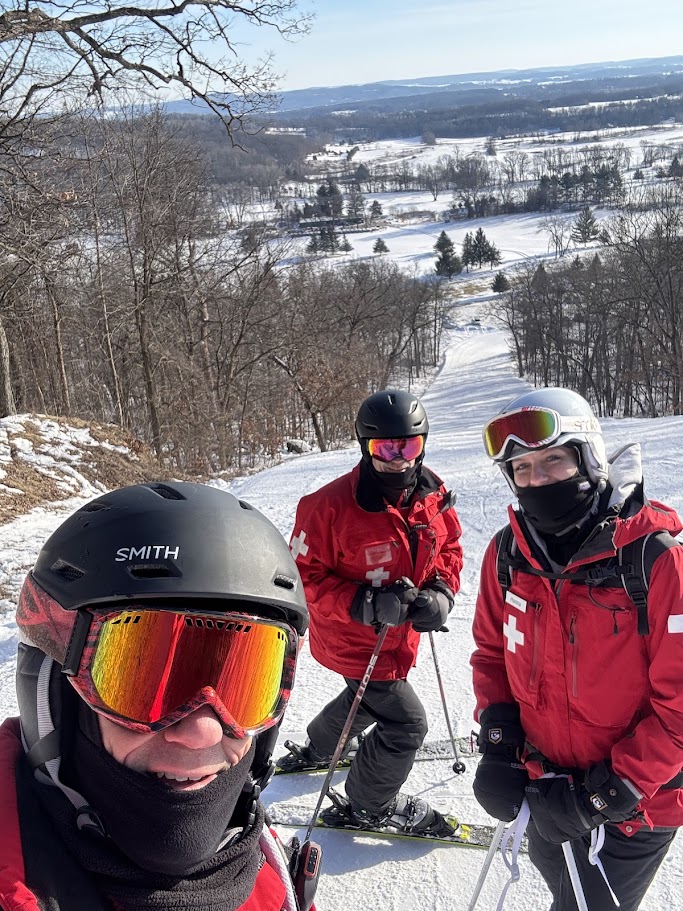
There are many great benefits to being a patroller, including meeting new people and making some great friendships, having a family activity to do during the winter months, and maybe most of all, helping people.
If you are interested in becoming a patroller, the first step is to send an email to: [email protected] We will then contact you, answer any other questions you might have and discuss next steps.
Devil’s Head Resort
Devil’s Head Resort was constructed in 1970 and is located in Merrimac, Wisconsin. The original resort consisted of a 92-room hotel, four chairlifts, a rope tow, ten runs, and a variety of bars and restaurants. 1970/71 was the resorts and ski patrol’s first season. The Devil’s Head Golf Resort was opened in the Spring of 1971 which was the premier of “original eighteen”.
Over the years, extensive improvements have been made: six additional chairlifts, numerous runs, a conference center, an additional 18-hole golf course, another 138 hotel rooms, more suites and condos. The ski patrol has been a member of the National Ski Patrol since the resort opened.
About National Ski Patrol (NSP)
NSP is a renowned organization committed to promoting safety and providing emergency care services in alpine environments across the country. With over 85 years of history, 600+ patrols, and over 30,000 members, we are the leading authority on mountain safety, comprised of volunteers and professionals dedicated to protecting and serving our mountain communities.

Why Join Us
Who We’re Looking For:
- Enthusiastic individuals with a love for skiing, snowboarding, or biking.
- Strong communication and teamwork skills.
- Willingness to learn and adapt to challenging situations.
- Commitment to safety and helping others.
There are two different paths to becoming a Devil’s Head patroller:
- Start with OEC Outdoor Emergency Care (OEC) then finish with Outdoor Emergency Transportation (OET) OR
- Start with Outdoor Emergency Transportation (OET) then then finish Outdoor Emergency Care (OEC)
Start with OEC then finish with OET – Individual steps
- Attend the orientation meeting, to learn about the time and financial commitments.
- Begin Outdoor Emergency Care (OEC) Course.
- Complete and pass the Outdoor Emergency Care Course (OEC).
- Attend orientation at the hill and Patroller 101 when the resort opens.
- During ski season – see “What can a patroller candidate do that has OEC certification?”
- Complete Outdoor Emergency Transportation (OET) Course – toboggan training and ski proficiency training when the hill opens, usually early December.
- Complete and pass toboggan training and ski proficiency (OET), usually in February.
Start with OET then finish with OEC – Individual steps
- Attend the orientation meeting, to learn about the time and financial commitments.
- See below for during season – What can a candidate can do based on Starting Point.
- Complete OET Course (toboggan training & ski proficiency) starting in early December.
- Complete and pass toboggan training and ski proficiency (OET), usually in February.
- Begin Outdoor Emergency Care (OEC) Course.
- Complete and pass the Outdoor Emergency Care Course (OEC).
- Attend orientation at the hill and Patroller 101 when the resort opens.
Outdoor Emergency Care (OEC) Course Completion
- This course teaches you to assess an injury or illness and render emergent first aid until the person can get advanced care. The Devil’s Head Ski Patrol OEC course typically begins in July and ends in early November each year. This course is usually held on Thursday nights on the west side of Madison. You will also need to complete a CPR course during this time. Attendance at each week’s course is mandatory.
Patroller 101
- Takes place in November in a classroom in which you learn about important aspects of Devil’s Head Resort and its Patrol, the history of NSP, as well as how to dress for the weather.
Outdoor Emergency Transportation (OET)
- It begins when the resort opens. At that time you work on ski or boarding proficiency and, depending on your ability level, may begin learning to run and handle toboggans for patient transport. This course is held on Wednesday evenings and runs through February.
What can a patroller candidate do that has the OEC certification?
- Perform First Aid same as regular patrollers (on hill, resort areas, and patrol room)
- Can wear RED patrol jackets
- Cannot transport empty or patients via toboggans until pass OET hill test
What can a patroller candidate do that started with OET – hill training during season (not completed OEC certified)?
- NO First Aid – cannot touch patients
- Can ONLY wear arm band/black chest harness with cross on it
- Cannot transport empty or patients via toboggans until pass OET hill test
- Ski with assigned patroller (mentor) and participate in all daily activities to learn about the patrol and resort runs, lifts, and toboggan locations.
- Arrive early enough for shift so booted up and ready to ski 15 minutes prior shift start time.
- Open chairs at start of shift and/or upon request from crew chiefs
- Carry radios to conduct Patrol Radio Communications
- Close lifts and sweep trails at designated times and/or upon request from crew chiefs
- Traffic control at accident screens
- Equipment Carry from accident screens
- Repack toboggans
- Complete accident forms
- Conduct Safety awareness with guests
WARNING to Skiers/Riders:
Under Wisconsin law (Wisconsin Skier Safety Act, 2012), each person engaged in skiing/riding has a duty to do all of the following:
- Obey all posted warnings and signs.
- Keep off of closed trails and out of closed areas.
- Know the range of his or her ability and engage in skiing or sledding within that ability.
- Assess the difficulty of the trails and terrains that are open to skiing or sledding.
- Maintain control of his or her speed and direction.
- Be able to stop or avoid other individuals or objects.
- Yield to other individuals engaged in skiing or sledding who are ahead or who are down the slope.
- Not stop at a point that will result in the individual obstructing a trail or not being visible from above.
- Yield to other individuals engaged in skiing or sledding who are uphill when starting downhill or when merging onto a trail.
- Be able to safely board, ride, and deboard any lift serving an area open to skiing or sledding.
- Board and deboard a lift only at designated sites.
- If involved in a collision with another participant in a snow sport that results in injury or death, not leave the vicinity of the collision before giving his or her name and current address to an employee of the ski area operator or a member of the ski patrol, except for the purpose of securing aid for a person injured in the collision. A person who leaves the scene of the collision for the purpose of securing aid shall give his or her name and current address after securing the aid.